

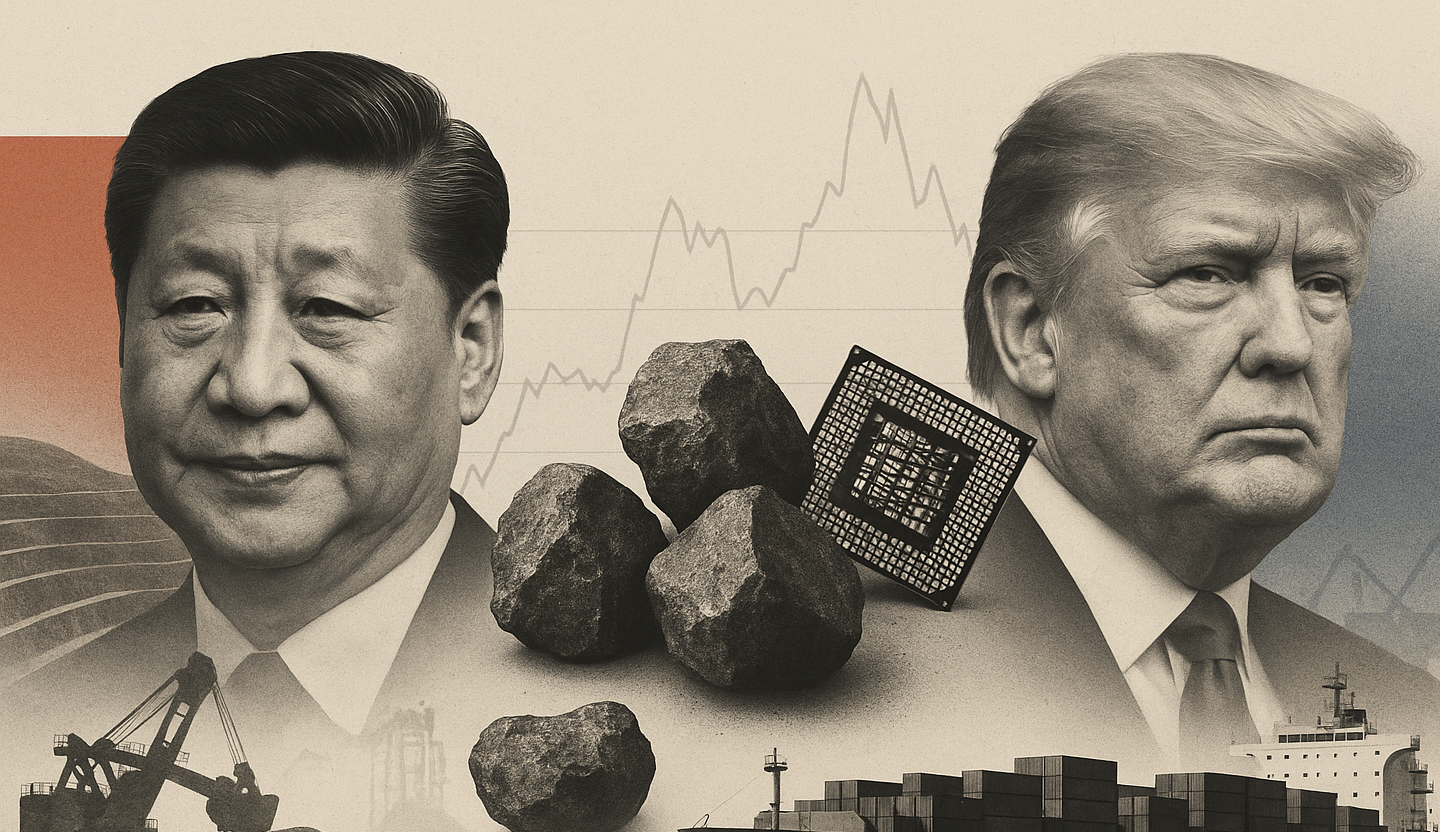

When President Trump told Volodymyr Zelensky he “had no cards,” he was speaking the dealmaking language of leverage — the only currency that ever truly mattered to him. Now it’s the United States that finds itself short on leverage. Beijing has identified a pressure point Washington can’t easily counter: its near absolute dominance in rare earths. It’s not a military threat, but it may be China’s strongest card yet — and a signal that the balance of power is shifting toward parity.
For decades, the United States has projected power through the dollar. Every major bank, trade route, and sanctions regime runs through its arteries. Now China is developing a version of that same influence — not through finance, but through the physical foundations of the modern economy: rare earths.
President Xi Jinping’s latest export controls mark a turning point. Beijing isn’t merely protecting a resource; it’s asserting jurisdiction over the global supply chain that depends on it — from magnet factories in Japan to wind-turbine producers in Europe. The message is clear: China’s dominance in refining and processing give it access if not governance over AI, quantum and the other technologies defining the future.
A Mirror Image of American Power
For years, Washington used the dollar’s dominance to shape global behavior. If you clear transactions in dollars, you play by American rules. Xi’s rare-earth policy applies the same principle: if your product contains Chinese-origin material or equipment, it’s now subject to Chinese oversight.
This inversion is striking. The U.S. controls the world’s financial plumbing; China is trying to control the world’s industrial wiring. One commands capital; the other commands materials. Both are essential, and neither can be substituted easily.
Two Levers of Dependence
Each side holds a unique instrument of coercion. America’s financial reach can freeze assets and starve liquidity, but it acts slowly. China’s mineral leverage can halt production lines within weeks. The difference is between strangling cash flow and cutting off oxygen.
Washington’s response — building alternative supply chains, stockpiling minerals, tightening sanctions — will take years. Meanwhile, Beijing’s grip over processing capacity gives it immediate influence, especially in clean-energy and defense manufacturing.
The Emerging Balance
The outcome depends on endurance. China’s economy remains deeply tied to the dollar system; it cannot fully weaponize rare earths without hurting itself. The United States, on the other hand, cannot easily replace China’s role in the materials that underpin modern industry. Both powers are discovering the limits of interdependence.
In a sense, this is the new equilibrium of globalization: mutual vulnerability disguised as dominance. The dollar and rare earths have become twin pillars of strategic control — one financial, one physical. Whoever manages their leverage with restraint, not excess, will ultimately shape the world order that follows.